
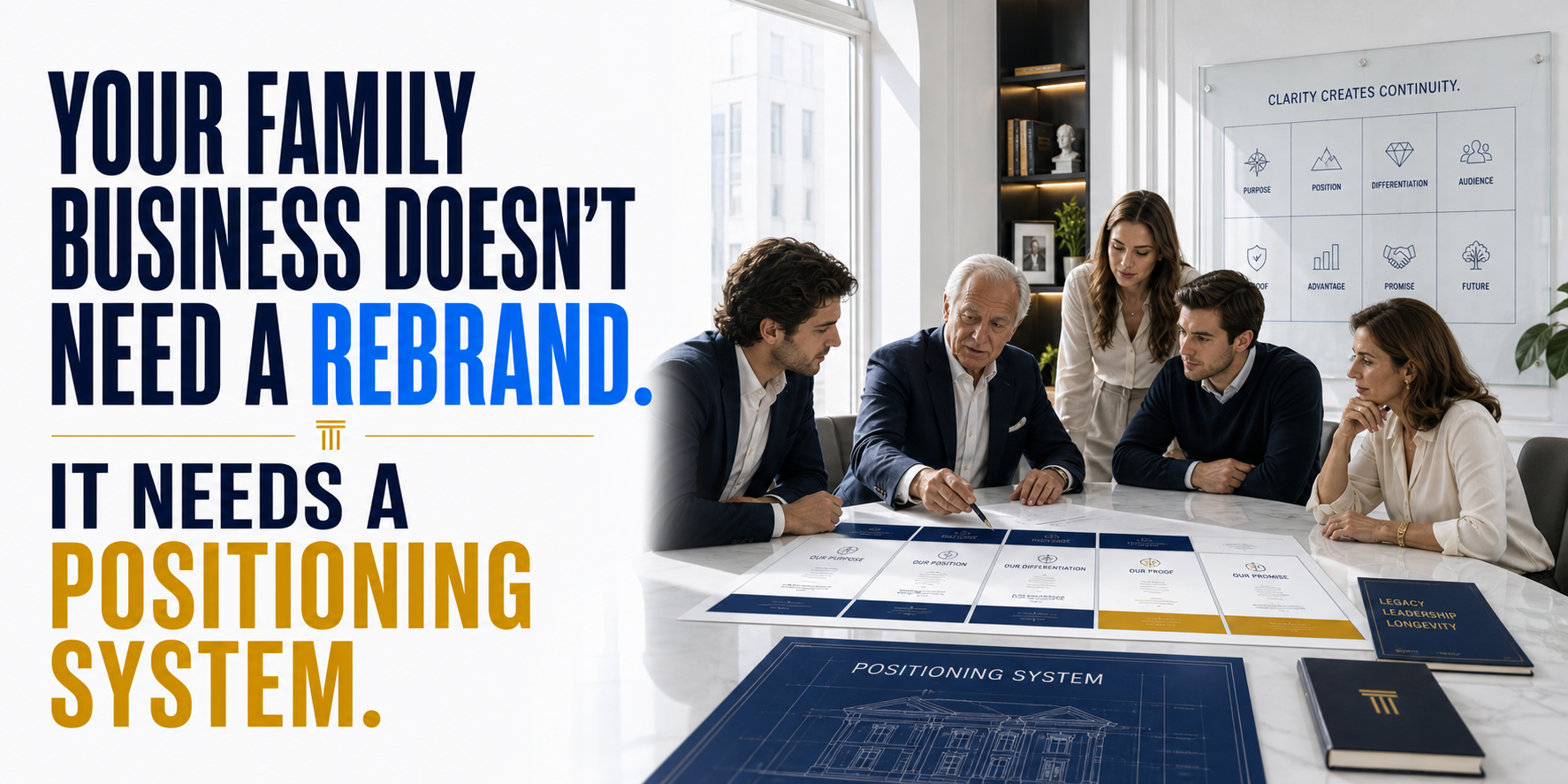
The second generation takes over. The first thing they do is call an agency.
New logo. New colors. New website. New tone of voice document that uses words like “dynamic” and “forward-thinking” and “innovative solutions.” The rebrand launches. The family patriarch looks at it with quiet discomfort. The market looks at it with quiet indifference.
Six months later, nothing has changed except the invoice.
The problem was never the logo. The problem was the absence of a positioning system — and a rebrand, no matter how expensive, cannot install what was never there.
Why the Rebrand Feels Like the Answer
The second or third generation CEO inheriting a family business faces a specific and uncomfortable situation. The company has equity — decades of relationships, a reputation built on reliability, a name that means something in certain rooms. But it also has limitations. The market has changed. The competitive set has expanded. The positioning that worked when the founder was personally selling — when the brand essentially was the founder — no longer translates to a company trying to scale, attract external talent, enter new markets, or raise institutional capital.
Something needs to change. That much is clear.
The rebrand presents itself as the obvious answer because it is visible, deliverable, and finite. You brief an agency, you run a process, you get an output. The logo changes. The website launches. The announcement goes out. It feels like transformation.
But a rebrand is execution-layer work. It changes the expression of a brand. It does not change the architecture underneath the expression. And if the architecture is unclear — if the positioning is undefined, if the identity has no through-line, if the company cannot answer “what we are specifically for and why that matters” with precision — then the new logo is just a more expensive version of the old confusion.
The market doesn’t respond to new logos. It responds to clarity. And clarity is a positioning problem, not a design problem.
What Is Actually Breaking in Most Family Businesses
The break is not visible from the outside. From the outside, a long-established family business often looks solid. A known name. A track record. A presence.
The break is structural and it sits at the identity layer.
Family businesses are typically built around a founder whose personal credibility was the brand. The founder knew everyone. The founder’s handshake was the positioning statement. The trust was personal, the differentiation was relational, and the competitive advantage was the founder’s ability to be in the room.
That model works — until it doesn’t scale.
When the second generation inherits the business, they inherit the relationships but not the mechanism. The market trusted the founder. They are now being asked to trust the institution. But the institution has no defined identity separate from the founder. There is no through-line that exists independently of the person who built the company. There is no positioning system that operates whether the CEO is in the room or not.
This is the actual break. Not the logo. Not the website. Not the fact that the visual identity looks like it was designed in 2003.
The break is that the brand’s ability to generate trust and preference depends entirely on personal presence — and personal presence does not scale, does not survive leadership transitions, and does not travel into new markets.
The Three Costs of a Positioning Vacuum
A family business operating without a defined positioning system pays for that absence in three specific ways. They are rarely named as positioning costs. They present as operational problems, market challenges, talent issues. But they trace back to the same root.
Cost one: The premium erodes.
A business built on founder relationships can hold a premium as long as the founder is present and active. When the transition happens — even a partial transition — the buyer’s justification for the premium weakens. They were paying for access to a specific person’s judgment, network, and accountability. The new generation hasn’t earned that premium yet, and the brand doesn’t give them a structural reason why the premium is still justified.
The result is pressure on pricing that feels like market competition but is actually a positioning gap. The market is asking: “Why should we pay this for you specifically?” and the brand has no answer that isn’t “because my father built this.”
Cost two: Talent cannot be attracted or retained.
The best people want to work for brands they can explain. A professional joining a family business that has no defined identity, no clear positioning in the market, no through-line that they can speak to in a job interview or a dinner conversation — that professional has a harder time building their own credibility by association. They can’t say “I work at a company that does X for Y” with the kind of precision that builds professional identity.
The family business that cannot attract external professional talent is not competing on compensation. It is competing on clarity. And it is losing because it has nothing clear to offer.
Cost three: Every new market entry starts from zero.
A well-positioned brand travels. When a company with a defined identity enters a new city, a new sector, or a new country, the positioning precedes it. The market can be primed. The introductory conversation has a foundation.
A family business with no defined positioning has to rebuild trust from scratch in every new context. Every new market entry is a cold start. The decades of equity in the home market do not transfer because there is no articulated positioning to transfer. There is only a name — and a name without a position is just a word.
What a Positioning System Actually Is
This needs to be defined precisely because the term is used loosely and often confused with branding deliverables.
A positioning system is not a tagline. It is not a brand book. It is not a mission statement crafted in a two-day offsite.
A positioning system is the set of strategic decisions — built in a specific order, maintained with discipline — that determines how a brand is perceived, who it attracts, what it charges, and why it is chosen over every available alternative.
It has six components. They run in this order and the order is not optional.
Category. What business are you actually in — defined not by your product but by the problem you solve. A construction company that defines its category as “construction” competes on price. A construction company that defines its category as “legacy real estate development for family-owned land assets” competes on fit.
Audience. Who is this specifically for — defined as a situation, not a demographic. Not “high net worth individuals.” The specific moment: a second-generation Saudi family that has inherited land and wants to develop it without losing the legacy value the first generation built.
Enemy. What is the default state your audience is trying to escape? For a family business, the enemy is often imitation — the pressure to look and behave like the large institutional competitors, losing the distinctiveness that made the founder’s company worth trusting in the first place.
Mechanism. How do you solve the problem — specifically. Not “we bring decades of experience.” The specific system, framework, or approach that produces the outcome your audience is paying for. Named and ownable.
Outcome. What is measurably different after engaging with you? Not “peace of mind” or “quality results.” The specific signal — the asset that increased in value, the transition that happened cleanly, the market that was entered without the mistakes every competitor made.
Voice. How does the brand communicate — in a way that is consistent, recognizable, and earned. Not trendy. Not borrowed from a global corporate playbook. Built from the actual character of the company and the specific trust signals that work in its market.
These six components, built and locked, become the filter through which every decision runs. The rebrand, if it is needed, comes after this. The agency brief is written from this. The new website is built on this. The sales team’s language is calibrated to this.
Without this underneath it, the rebrand is decoration applied to a structure that hasn’t been examined.
The Legacy Trap
There is a specific failure mode unique to family businesses that needs to be named directly.
The attempt to modernize while preserving legacy — without a positioning system to navigate the tension — usually destroys both.
The new generation strips the founder’s story from the brand because it feels old. They replace the relational warmth that made the business trusted with corporate language that sounds like every competitor. The market loses the thing that made the brand worth choosing. The brand gains nothing in return because the new positioning is not built — it is borrowed from a global template that has nothing to do with this company’s actual differentiation.
The result is a brand that is neither what it was nor what it is trying to become. It loses the equity of the legacy and fails to build new equity in its place. The logo is modern. The identity is empty.
The positioning system is what prevents this. It is the mechanism that allows a family business to evolve without drifting. It defines what must be preserved — the specific character, credibility signals, and trust mechanisms that are genuinely differentiated — and what must be rebuilt for the new context. That distinction is the work. It is strategic work, not creative work. And it has to be done before anything visible changes.
The System: What to Build Before the Agency Brief
The sequence that produces a positioned family business — one that can scale, attract talent, hold its premium, and enter new markets — runs in five steps. All five happen before a logo is touched.
Name the founder’s actual differentiation. Not the story the family tells at dinner. The specific thing — the mechanism, the judgment, the network, the approach — that made buyers choose this company over every alternative. That differentiation is an asset. Most of it can be translated into a system that doesn’t require the founder’s physical presence. Find it. Name it. Don’t let the rebrand erase it.
Define the audience as the company they are becoming, not the company they were. Who is the next-generation buyer — their situation, their fears, their definition of a successful outcome? This buyer may be different from the founder’s original buyer. The positioning system must speak to this buyer without abandoning the market the company already owns.
Name the enemy explicitly. What is the family business competing against — not in product terms, in perception terms? Is the enemy the large institutional player that looks more sophisticated but delivers less? Is it the new market entrant that is cheaper but untested? The enemy determines the differentiation. Name it.
Build the mechanism independently of the founder. The positioning system must be able to operate without the founder in the room. The mechanism — the specific way this company solves the problem — must be documented, trained, and embedded in how every team member speaks about the business. This is the transition from personal brand to institutional brand. It does not happen automatically. It is built.
Write the positioning statement before the creative brief. One sentence. Specific enough to be useful. Built from the five components above. This sentence goes at the top of every agency brief, every new hire onboarding document, every partnership proposal. It is the anchor. Everything creative is built from it. Nothing that contradicts it gets approved.
Proof
A second-generation CEO of a regional trading and distribution company inherited a business with forty years of relationships and no articulated positioning. The first instinct was a rebrand — new name, new visual identity, new website. The rebrand was paused. The positioning system was built first: category redefined, audience sharpened to a specific buyer situation in the Gulf, enemy named, mechanism documented. The rebrand that followed — after the system was in place — cost less, took less time, and produced a result that the market actually responded to. Within eighteen months, the company had entered two new Gulf markets without a cold start. The positioning had preceded them. New enterprise clients cited the clarity of what the company stood for as the primary reason for engaging. The rebrand, in the end, was the easy part. The system was the work.
The logo is not the problem. The absence of a through-line is the problem. A new logo on an undefined identity is not modernization. It is decoration. Build the system first. Then brief the agency.