
This is not a post about what positioning is.
Every brand strategist, every marketing consultant, every business school curriculum covers what positioning is. The frameworks exist. The definitions are settled. The literature is extensive. Any founder, CMO, or business owner who has spent ten minutes reading about brand strategy knows the vocabulary.
And yet most brands don’t have it.
Not because they don’t understand it. Because they are avoiding it — deliberately, consistently, and at significant long-term cost.
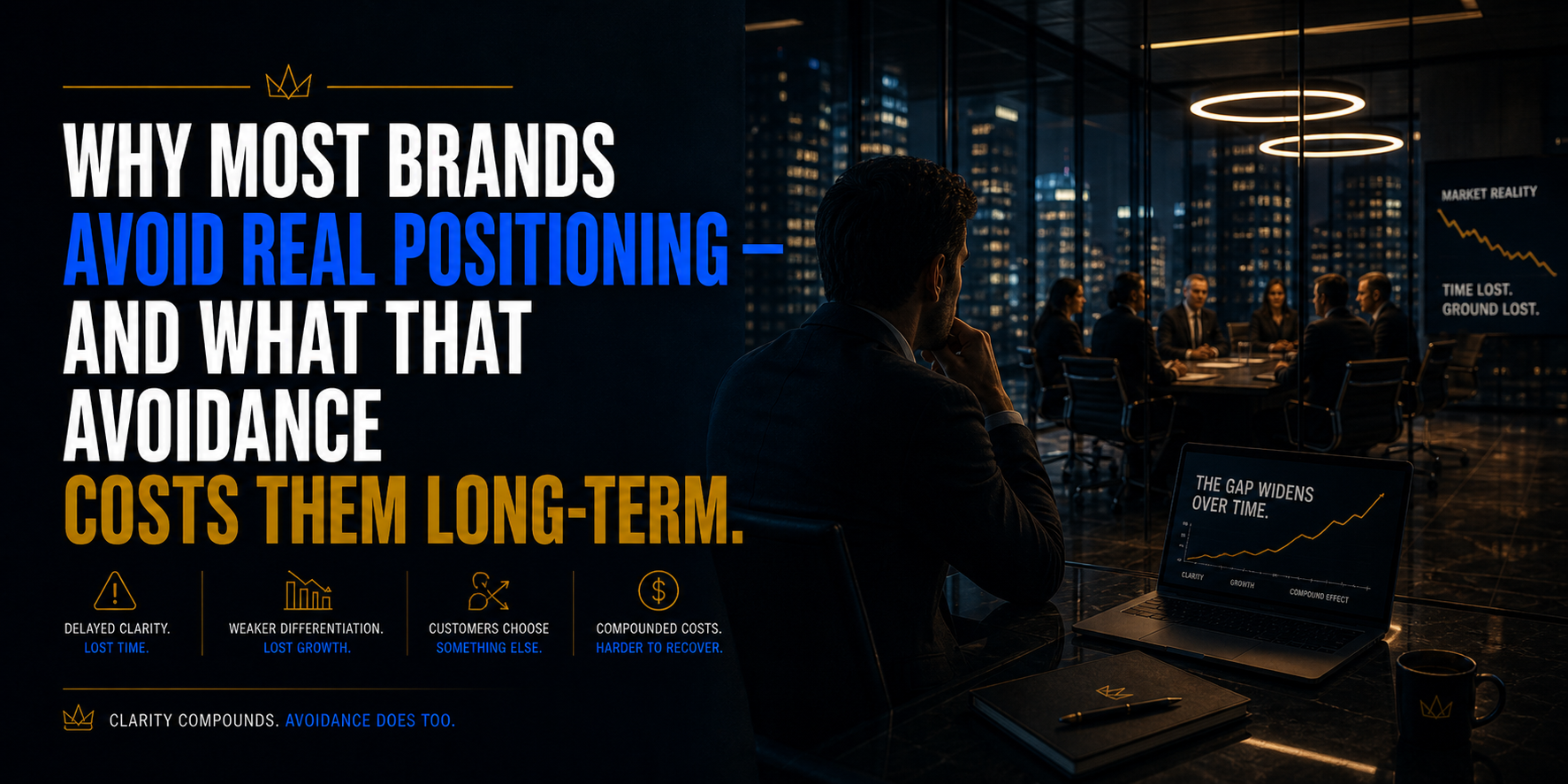
This post is about the avoidance. Why it happens. What it costs. And why the brands that stop avoiding it compound an advantage that their competitors cannot close without doing the same work.
The Avoidance Is Not Ignorance
This needs to be established first because the assumption — the comfortable one — is that brands lack positioning because they don’t know what it is or how to build it.
That assumption protects the brand from the harder truth.
The harder truth is that most brands know they need positioning and have chosen, consciously or unconsciously, not to build it. Not because they ran out of time. Not because they didn’t have the budget. Because building real positioning requires making decisions that feel dangerous — decisions that the brand is not ready to make, or is not willing to defend, or is afraid will cost them something they are not prepared to lose.
The avoidance is rational in the short term. It is catastrophic in the long term. And it is almost always dressed up in language that sounds reasonable — language that makes delay feel like prudence and vagueness feel like flexibility.
That language deserves to be named.
The Six Languages of Avoidance
“We don’t want to limit ourselves.”
This is the most common form of the avoidance and the most seductive because it sounds like strategic thinking.
The logic goes: if we define our positioning too specifically, we will exclude potential customers. If we say we are for X, then Y and Z will not consider us. Our market is broad and our product serves many types of buyers, so our positioning should reflect that breadth.
This logic is wrong in a specific and measurable way.
Positioning is not a constraint on who can buy the product. It is a signal to the market about who the product was built for first, and best. The customer who is not the primary positioning target can still buy — and often does, precisely because the specificity of the positioning communicates genuine expertise. The specialist is trusted by the non-specialist because the specialist has demonstrated depth that the generalist cannot.
The brand that refuses to define a primary audience in an attempt to keep every door open keeps every door slightly open and none of them fully open. The buyer who walks past a door that is only slightly open does not push it. They walk to the door that is open all the way — the door of the brand that was clearly expecting them.
Specificity does not limit the market. It unlocks it.
“Our product speaks for itself.”
This is the failure mode of the technically excellent brand — the company that has built something genuinely superior and believes that quality, properly communicated, produces preference.
It does not.
Quality is the floor. In every competitive market, multiple products clear the quality floor. The buyer is not choosing between qualified and unqualified. They are choosing among qualified options — and among those options, they are choosing based on clarity of fit, not depth of specification.
The product that speaks for itself speaks to the buyer who is already deeply informed, already invested in the evaluation, already determined to find the right answer. That buyer is a small fraction of the available market. The rest of the market is making decisions with incomplete information, under time pressure, with competing priorities. That buyer needs something simpler than a product demonstration. They need a position — a clear signal that this brand was built for someone like them.
The product that speaks for itself is silent to the buyer who needs a reason before they start listening.
“We are still figuring out our market.”
This is the startup version of the avoidance and it has a specific window of legitimate applicability — approximately the first six months of pre-product-market-fit exploration.
After that window, this statement is not a description of strategic reality. It is a defense mechanism.
The company that has traction — that has paying customers, a repeating use case, a pattern of who buys and why — has already found its market. It has not named it. That is a different problem. And naming it feels like a commitment that the founder is not ready to make, because commitment means being wrong in public if the commitment turns out to be wrong.
But the market is already deciding what the brand is, whether the brand participates in that decision or not. The brand that refuses to define its own position does not remain undefined in the market’s mind. It gets defined by default — by the category it was last compared to, by the competitor it was last placed next to, by the most recent description a journalist or investor used. That default definition is almost never the one the brand would have chosen.
Choosing is not premature. Choosing is the work.
“We tried positioning once and it didn’t stick.”
This one is worth examining carefully because it contains a real experience — a brand that invested in positioning work that produced a document no one used.
The failure was not positioning. The failure was surface-level positioning — a tagline exercise, a values statement, a brand personality framework that was developed in isolation from the actual strategic decisions about audience, enemy, mechanism, and outcome. The deliverable was creative. The foundation was missing.
Real positioning does not fail to stick because the market rejected it. It fails to stick when it was never built from the strategic layer down. A tagline with no identity underneath it is decoration. Decoration does not stick because there is nothing for it to adhere to.
The brand that tried positioning and found it didn’t stick did not try positioning. It tried the surface of positioning — and found, correctly, that the surface without the structure does not hold. The answer is not to abandon the project. It is to build it properly.
“Positioning is for consumer brands.”
This is the B2B version of the avoidance — the belief that institutional buyers make rational decisions based on specifications, track records, and relationships, and that the identity-level work of positioning is relevant for companies selling to consumers but unnecessary for companies selling to procurement committees.
This belief misunderstands how institutional decisions are made.
Every procurement committee is staffed by humans who bring their cognitive shortcuts, their instincts, and their pre-formed impressions to every decision they make. The brand that has a defined position in the mind of the decision-maker before the RFP is issued has an advantage that no proposal document can fully overcome. The brand that is generic — that looks like every other vendor in the category — enters the evaluation on equal footing and competes on price.
B2B buyers do not make purely rational decisions. They make defensible decisions — decisions they can justify to their organization, their management, and themselves. A brand with a clear position is easier to justify than a brand without one. “We chose them because they are the only firm that specifically serves companies in our situation” is a cleaner justification than “we chose them because their proposal scored highest on our evaluation matrix.”
Positioning matters in B2B. It operates differently than in consumer markets — through different channels, over different timelines, with different proof requirements. But the mechanism is the same. Clarity produces preference. Preference precedes the proposal.
“We’ll build the brand once we have more scale.”
This is the most expensive form of the avoidance because it contains a premise that sounds logical but is structurally false: that positioning is a reward for growth rather than a driver of it.
The premise is that scale comes first, then the brand follows. Get the revenue, build the team, establish the market presence, and then — once the company is large enough, funded enough, credible enough — invest in the positioning.
The causality is inverted.
Positioning is not what companies do after they grow. It is one of the mechanisms by which they grow. The brand that defines its position early establishes a compounding advantage: every customer acquired under the positioning reinforces the position, every referral generated is filtered by the position, every hire attracted is aligned to the position, every investor briefed has a clear picture of what they are backing. The positioning accelerates each of these processes.
The brand that waits for scale to earn the right to define its position is waiting for permission from a market that is actively forming opinions about what the brand is without that permission being given. By the time the brand is large enough to feel ready for the positioning conversation, the market has already assigned it one. Undoing that default positioning — the one the market assigned in the absence of the brand’s own definition — is exponentially more expensive than building the right positioning from the beginning.
Scale is not the prerequisite for positioning. Positioning is a prerequisite for the kind of scale that compounds.
What the Avoidance Actually Costs
The cost of positioning avoidance is not a line item. It is distributed across the entire operation and presents as something else — competitive pressure, talent problems, margin erosion, slow growth. It is never labeled as what it is.
Here is what it actually costs.
It costs every sale that required more persuasion than it should have.
Every time a salesperson has to explain what the company is before they can explain what it does, the positioning is doing negative work. The undefined brand forces the sales process to carry the weight of identity establishment — a weight it was not designed to carry. Every sale that closes under that weight costs more in time, in attention, and in probability than the same sale would cost from a defined position.
It costs the premium that the market would have paid but wasn’t given a reason to.
Price is a positioning outcome. The brand that occupies a specific, valuable position in a specific buyer’s mind commands a premium because the buyer has no direct comparable. The brand that occupies a generic position in a crowded category competes on price because price is the only remaining differentiator. The premium that the undefined brand did not charge — over five years, across thousands of transactions — is the compounded cost of the avoidance. It is not visible. It never appears on a balance sheet. It is real.
It costs the talent that chose a clearer competitor.
The best candidate for every role evaluated this brand and chose the competitor with the clearer identity. Not because the competitor paid more. Because the competitor knew what it was and communicated it with enough precision that the candidate felt they were joining a direction, not a company. The talent the undefined brand did not attract — the product leader, the senior engineer, the strategic hire who would have changed the trajectory — is the human cost of the avoidance. It compounds in the same direction as the revenue cost. Invisibly. Permanently.
It costs the compounding that clarity would have produced.
This is the largest cost and the least visible. A defined position compounds. Every piece of content reinforces it. Every customer acquired under it adds to the proof. Every referral generated from it arrives pre-aligned. Every year the positioning is held and communicated consistently, the position strengthens. The competitor who has to spend to acquire what the positioned brand earns is falling further behind with every passing quarter — not because they are worse at execution but because they are working without the compounding that clarity produces.
The undefined brand does not hold a neutral position while it waits to define itself. It falls behind the compound curve. And the distance between where it is and where a positioned competitor is grows every quarter the avoidance continues.
Why the Avoidance Persists Despite the Cost
If the costs are this clear and this large, why does the avoidance persist?
Because the costs are invisible in the short term and the risks of positioning feel immediate.
The brand that defines its position today cannot see, on that day, the premium it will charge three years from now because of that decision. It cannot see the candidate who will apply next year specifically because the positioning gave them a reason. It cannot see the referral flywheel that will reduce acquisition cost in eighteen months. The benefits of positioning are deferred, distributed, and difficult to attribute.
The risks feel present. The brand makes a specific claim and a competitor makes a better one. The brand defines a specific audience and a sale is lost because the buyer was outside that definition. The brand names an enemy and the enemy responds. These feel like losses that the positioning caused — when in fact they are clarifications that the positioning produced. The competitor whose claim is stronger is a signal to sharpen the mechanism. The sale lost outside the positioning is a sale that would have produced misaligned retention and no referral. The enemy who responds is a sign that the position has landed.
Every risk of positioning is a clarification of where the brand actually stands. Every cost of avoidance is an invisible tax on every decision the brand makes without the clarity that positioning would have provided.
The brands that stop avoiding are not braver than the brands that continue. They are simply more willing to accept short-term clarity in exchange for long-term compounding.
What Stops the Avoidance
The avoidance stops when the brand makes one decision: to treat positioning not as a creative project with a deliverable but as a strategic system with a maintenance requirement.
Positioning is not a campaign. It is not a rebrand. It is not a workshop output. It is the set of decisions — about audience, enemy, mechanism, outcome, and voice — that govern every subsequent decision the brand makes about how it presents itself to the market.
Those decisions, made precisely and maintained consistently, produce the compounding that the avoidance has been deferring.
The work is not complicated. It is specific. It requires answering six questions with more precision than the brand has previously been willing to commit to.
Who is this specifically for — defined as a situation, not a demographic.
What is specifically broken for them — defined as a root cause, not a symptom.
Which enemy is active — Noise, Imitation, or Guesswork — named specifically for this audience in this market.
What is the mechanism — the specific system that solves the problem in a way no alternative does.
What changes after — the specific, measurable outcome that the buyer reaches.
What is the voice — the specific character of how the brand communicates, built from actual conviction rather than borrowed from a style guide.
These six answers, held consistently across every touchpoint, every piece of content, every sales conversation, every hire, every investor update — produce the positioning system that the avoidance has been preventing.
The system does not produce results on the day it is built. It produces results that compound from the day it is built. The brand that builds it today will not feel the full advantage for six months. It will feel a significant advantage in twelve. It will feel a structural advantage in twenty-four — an advantage that competitors who are still avoiding the work cannot close without doing the same work from scratch.
The Market Is Positioning Your Brand Whether You Are Or Not
This is the thing the avoidance ignores.
The decision not to define positioning is not a decision to remain undefined. It is a decision to let the market define the brand by default — through the comparisons it makes, the categories it places the brand inside, the associations it builds from whatever signals the brand produces without strategic intent.
That default positioning is almost never favorable. It is the average of every impression the brand has made without a through-line. It is the residue of inconsistency. It is the position of a brand that could not decide what it was, assigned by a market that needed to put it somewhere.
The brand that builds its own positioning is not fighting the market. It is leading the market — giving it the specific associations, the specific comparisons, the specific category to place the brand inside. The market responds to that leadership. It accepts positions that are offered with conviction and consistency. It assigns positions by default to brands that offer nothing.
There is no neutral ground. There is no option to remain unpositioned while the work gets done. The positioning question is always being answered. The only choice is whether the brand answers it or the market does.
Proof
Two professional services firms launched in the same market in the same year. Same category. Similar capabilities. Similar founding team experience. One defined its positioning in the first quarter — specific audience, named enemy, documented mechanism, locked voice. The other delayed, citing the need to understand the market better before committing. Three years later, the positioned firm was generating the majority of its new business from inbound referrals, commanded a fee premium of approximately thirty percent above the category average, and had hired three senior professionals who cited the clarity of the firm’s market position as the primary reason for joining. The second firm was still primarily outbound, competing on price in final-stage pitches, and had lost two potential senior hires to competitors in the previous year. The capabilities gap between the two firms had not grown. The positioning gap had compounded every quarter for three years. The second firm’s leadership described the gap as a business development problem. It was a positioning problem that had been deferred for three years — and three years of compounding is not recovered in a quarter.
The avoidance is a choice. It is made every quarter that the positioning questions remain unanswered, every campaign that runs without an identity underneath it, every hire made without a through-line to attract the right person, every sale closed at a discount because the brand gave the buyer no reason to pay the premium. The cost is invisible until it isn’t. Build the positioning system. Not when the company is ready. Now — because the market is already deciding what you are, and the longer you wait, the more expensive it becomes to correct what it decides.