The facilities are excellent. The curriculum is accredited. The teachers are qualified. The campus is well-maintained and the extracurricular program is broad. The open day is professionally organized and the admissions team is responsive.
And yet enrollment is below target. Again.
The principal reviews the numbers. The board asks about the marketing budget. The admissions director suggests a discount on the registration fee. Someone recommends a referral incentive program. Someone else suggests the school needs a stronger social media presence.
None of those are the problem.
The problem is visible the moment a parent opens three school websites in the same evening — which is exactly what every parent considering private education does. The websites look the same. The language is the same. The values listed are the same. Excellence. Community. Future-ready. Holistic development. Every school in the city is saying the same thing with a different logo on top.
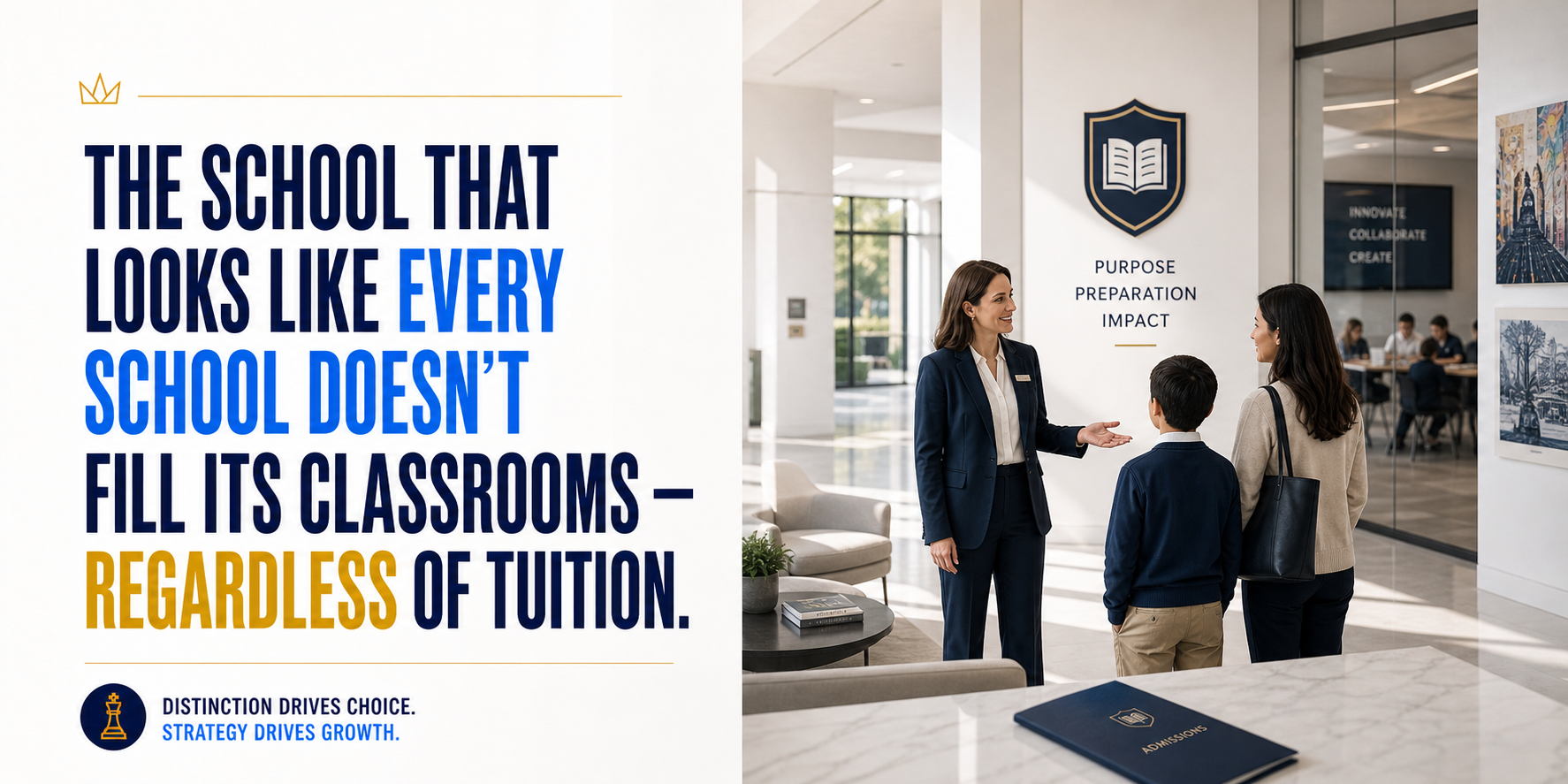
The parent cannot tell them apart at the identity level. And a parent who cannot tell schools apart does not choose on merit. They choose on proximity, on price, or on whoever their neighbor happened to recommend last week.
That is the enrollment problem. It is not a marketing problem. It is a positioning problem. And it will not be solved by a better open day.
How Parents Actually Make the Decision
The decision to enroll a child in a private school is one of the highest-stakes purchasing decisions a family makes. It is financially significant, emotionally loaded, and extremely difficult to reverse once made. The parent who gets it wrong does not simply switch products — they uproot a child’s social world, academic trajectory, and daily experience.
That weight does not make parents more rational. It makes them more reliant on signals they can read quickly and trust intuitively.
The parent evaluating private schools is not running a formal assessment against weighted criteria. They are doing something simpler and more human: they are looking for the school that feels like it was built for their child. Not the best school in the abstract. The right school for their specific child’s specific needs, in their specific family’s specific context.
That feeling — the recognition that this school understands what we are looking for — is not produced by a curriculum document or a facilities tour. It is produced by positioning. By the accumulated set of signals that communicate, before a single question is asked, that this institution has made a specific set of choices about who it serves and what it believes education should produce.
The school that has made those choices visibly and precisely gives the parent the one thing the decision requires: certainty. Not certainty that the school is the best in the city. Certainty that it is the right one for them.
The school that has not made those choices — that has hedged every positioning decision in an attempt to appeal to everyone — gives the parent nothing to hold. And parents who have nothing to hold ask for a discount, compare on location, and ultimately make the decision by default rather than by conviction.
The Sameness Problem in Private Education
Walk through the websites of ten private schools in any major Saudi city. Count how many times the following words appear: excellence, innovation, holistic, community, future leaders, global citizens, nurturing environment, world-class.
Every school uses these words. Every school believes these words describe something meaningful about its identity. And every school that uses these words is, from the parent’s perspective, saying the same thing as every other school.
This is the sameness problem. It is not produced by laziness or lack of ambition. It is produced by a specific strategic failure: the attempt to appeal to every parent rather than to a specific kind of parent.
The school that wants to attract families who value academic rigor above social development makes a different set of choices than the school that values social development above academic rigor. The school that is built for the child who needs structure makes different decisions than the school built for the child who needs creative freedom. The school that serves the child of expatriate professionals navigating multiple educational systems makes different promises than the school that serves the Saudi family investing in generational continuity.
These differences are real. Parents feel them. But most schools refuse to make them visible because they are afraid that visible specificity will exclude families they could have enrolled.
The fear is precisely backward.
Visible specificity does not reduce enrollment. It improves enrollment quality — the alignment between what the school offers and what the enrolled family genuinely needs. And improved enrollment quality produces the thing that fills classrooms faster than any marketing budget: genuine word-of-mouth from families who feel they found exactly what they were looking for.
What Unclear Positioning Costs a School
The commercial cost of undefined positioning in private education is distributed across three areas. They are never labeled as positioning costs in the school’s financial review. They should be.
Enrollment conversion is structurally low.
The school without a defined position has to work harder at every stage of the enrollment funnel. The initial inquiry requires more follow-up because the parent did not arrive with a specific reason to choose this school — they arrived because it was on a list. The open day has to carry more selling weight because there is no positioning doing pre-work before the parent arrives. The admissions conversation has to persuade rather than confirm. Each of these stages is more expensive in staff time, in attention, and in the probability of losing the family to a competitor who happened to close the conversation more smoothly.
Discounting becomes structural.
A school that cannot articulate what makes it specifically the right choice for a specific family has no defense against price pressure. The parent who is not convinced by the positioning asks about the fees. The school that has no answer to “why here specifically” at the identity level negotiates at the price level. Discounts are offered, registration fees are waived, payment plans are extended. The revenue per enrolled student decreases. The margin problem compounds year over year. The school attributes it to market competition. It is a positioning problem that manifests as a pricing problem.
Retention is weaker than it should be.
The family that enrolled without genuine identity alignment — that chose the school because it was convenient, or slightly cheaper, or because a friend recommended it without a specific reason — has a shallow relationship with the institution. When something goes wrong — a teacher change, a policy adjustment, a peer conflict — the family’s threshold for switching is low. They are not invested in the identity of the school. They are invested in a transaction. Transactions end when a better transaction appears.
The school that retains families through identity alignment — families who chose it because it specifically reflects their values and specifically serves their child’s specific needs — retains those families through disruption because the relationship is not transactional. It is chosen. And chosen relationships are resilient in ways that transactional ones are not.
The Vision 2030 Enrollment Dynamic
The Saudi private education market is not static. Vision 2030 has accelerated several forces that make positioning more consequential now than it was five years ago.
The number of private schools is increasing. New international school operators are entering the market. Existing schools are expanding campuses. The supply of private education seats is growing faster than the growth in families who can afford them. In a market with limited supply, schools fill on availability. In a market with expanding supply, schools fill on positioning.
The Saudi parent is more informed and more demanding. Access to information about international educational models, curriculum comparisons, and school performance data has produced a generation of parents who approach the enrollment decision with more sophistication than their own parents did. They are not choosing the private school because it is the private school. They are evaluating specific schools against specific criteria that reflect specific values about what education should produce.
The expatriate professional community — a significant source of enrollment for many private schools in Saudi Arabia — is highly mobile. These families have often enrolled children in multiple school systems across multiple countries. They have a reference point for what a school with a clear identity looks and feels like. They recognize immediately when a school has no defined position. And they choose the one that does.
These three forces together mean that the enrollment advantage is shifting toward positioned schools and away from generic ones — and that shift is accelerating. The school that builds its positioning now is building an asset that becomes more valuable as competition increases. The school that waits is not maintaining its position. It is losing it by default.
What the Open Day Cannot Fix
The open day is where most schools invest their positioning energy. The facilities are prepared. The students are dressed and briefed. The staff are present and engaged. The presentation is polished. The tour is well-sequenced.
And the parent leaves with a brochure they will put in a drawer with three other brochures from three other schools whose open days were equally polished.
The open day cannot fix a positioning problem because the positioning problem exists before the parent arrives. The decision about whether this school feels right for this family has already begun forming from the first touchpoint — the search result, the website, the Instagram page, the conversation with a friend who had visited. By the time the parent arrives at the open day, they are either confirming a feeling they already have or trying to manufacture one they don’t.
The school that has a defined position arrives at the open day with work already done. The parent who walks through the door has already read something, seen something, or heard something specific — not generic — about who this school is for and what it believes. The open day is confirmation. The conversation is alignment. The enrollment follows naturally.
The school that has no defined position arrives at the open day with everything to do. The open day has to establish identity, build trust, communicate differentiation, and close enrollment all in a two-hour visit. That is more weight than an open day can carry. And most open days fail under it — not because they were poorly organized but because they were asked to solve a positioning problem that should have been solved upstream.
The System: Build the Identity Before the Enrollment Season
The sequence that moves a private school from generic presence to owned position runs in five steps. They happen before the next enrollment cycle opens, before the next campaign is briefed, before the next open day is planned.
Define the school’s identity through the lens of the family it is specifically built for.
Not the family it wants to attract in the abstract. The specific family — their values, their concerns about their child’s education, the specific outcome they are investing in, the specific failure mode they are trying to avoid. A school built for the Saudi family that prioritizes Arabic language and Islamic values within a rigorous academic framework is not the same school as the one built for the expatriate family seeking seamless continuity with international university admissions. Both are valid positions. Neither is served by language that tries to be both simultaneously.
Name what this school makes possible that the generic alternative does not.
Not “an excellent education.” The specific transformation: the child who arrives anxious about academic performance leaves with the study systems and self-assessment habits that make them genuinely independent as a learner. Or: the expatriate family that has changed schools four times in eight years finds, for the first time, an institution whose educational philosophy is clear enough that the transition into the next system is planned and supported rather than improvised. The specificity of the transformation is the positioning. It is the answer to “why here” that no other school in the city can give.
Identify the enemy.
In private education, the enemy is almost always one of two things. The first is the generic school that offers everything broadly and nothing deeply — that has an arts program, a sports program, a science program, and an Islamic studies program, all of average quality, none reflecting a specific educational conviction. The parent who has had this experience is actively looking for something different. The school that names this enemy in its positioning speaks directly to that parent. The second enemy is the misalignment between school and family — the experience of enrolling in a school that looked right from the outside and felt wrong once the child was inside it. The school that names this enemy and demonstrates how its positioning prevents it is offering the parent relief from their deepest enrollment fear.
Build the proof in the language of the parent, not the institution.
The testimonial that says “the school has an excellent academic program” is institutional language. It is not proof. Proof is: “My daughter was struggling with reading in Arabic. Within one academic year at this school, she was reading independently and asking for books. The approach here is different from anything we had seen before.” That specificity is not a marketing exercise. It is a positioning asset — one that speaks directly to the parent who has a child with a similar challenge and has been disappointed by generic interventions. Collect these stories. Format them. Deploy them at every stage of the enrollment journey.
Embed the positioning in every touchpoint before the open day.
The website headline. The Instagram bio. The response to the first inquiry email. The script the admissions team uses when a parent calls. The language of the tour guide on the open day. All of these are positioning touchpoints. All of them should reinforce the same identity — the same specific answer to “who is this school for and what does it make possible.” When every touchpoint says the same specific thing, the positioning compounds. When every touchpoint says something slightly different, the positioning diffuses and the parent cannot form a clear impression.
The Referral Flywheel
There is a compounding dynamic in private education that makes positioning especially consequential over time.
The parent who enrolled with genuine identity alignment — who chose the school because it specifically reflected their values and specifically served their child — becomes the school’s most powerful enrollment asset. They do not refer generally. They refer specifically. They say “this school is perfect for families like ours because X” — and X is a specific articulation of the school’s positioning, transmitted through a trusted personal relationship.
That referral arrives pre-aligned. The family that receives it has already been told who this school is for. If they recognize themselves in that description, they arrive at the inquiry stage already convinced. The admissions conversation is confirmation. The enrollment follows without the full friction of a cold conversion.
This flywheel does not exist in schools without defined positioning. The satisfied parent of a generic school refers generically. “It’s a good school.” That referral does not pre-align anyone. It adds the referred family to the general pool of families who need to be persuaded from scratch.
The difference between these two referral types — specific and generic — compounds dramatically over time. The school with positioning-aligned families builds a referral engine that fills classrooms with less and less spend per enrolled student every year. The school with generic satisfaction builds a referral pool that is broad, weakly filtered, and expensive to convert.
Positioning does not just fill the current year’s classrooms. It builds the mechanism that fills every subsequent year’s classrooms with progressively less effort.
Proof
A private school in the Eastern Province had been operating for six years with consistent quality and inconsistent enrollment. Open days were well-attended but conversion rates were below the industry average. The analysis revealed that the school’s communication was indistinguishable from four competitors within a ten-kilometer radius — same values language, same facilities emphasis, same generic aspiration. The positioning was rebuilt around a specific family profile: Saudi families with academically ambitious children who had been underserved by large international schools that prioritized social breadth over academic depth. The enemy was named: the large-campus international school experience where the child is one of many rather than known as an individual. The website, the open day presentation, and the admissions team’s language were rebuilt from this position. The following enrollment cycle, conversion from open day to enrolled student improved significantly. The change that drove the improvement, according to the admissions team’s post-enrollment surveys, was consistent: parents reported that the school was the only one they had visited that seemed to know exactly who it was for — and that their family was it.
The parent evaluating private schools is not looking for the best school. They are looking for the right school — the one that was clearly built for a family like theirs. The school that can communicate that with precision does not need a better open day. It needs a defined position. Build the identity first. The enrollment follows.