
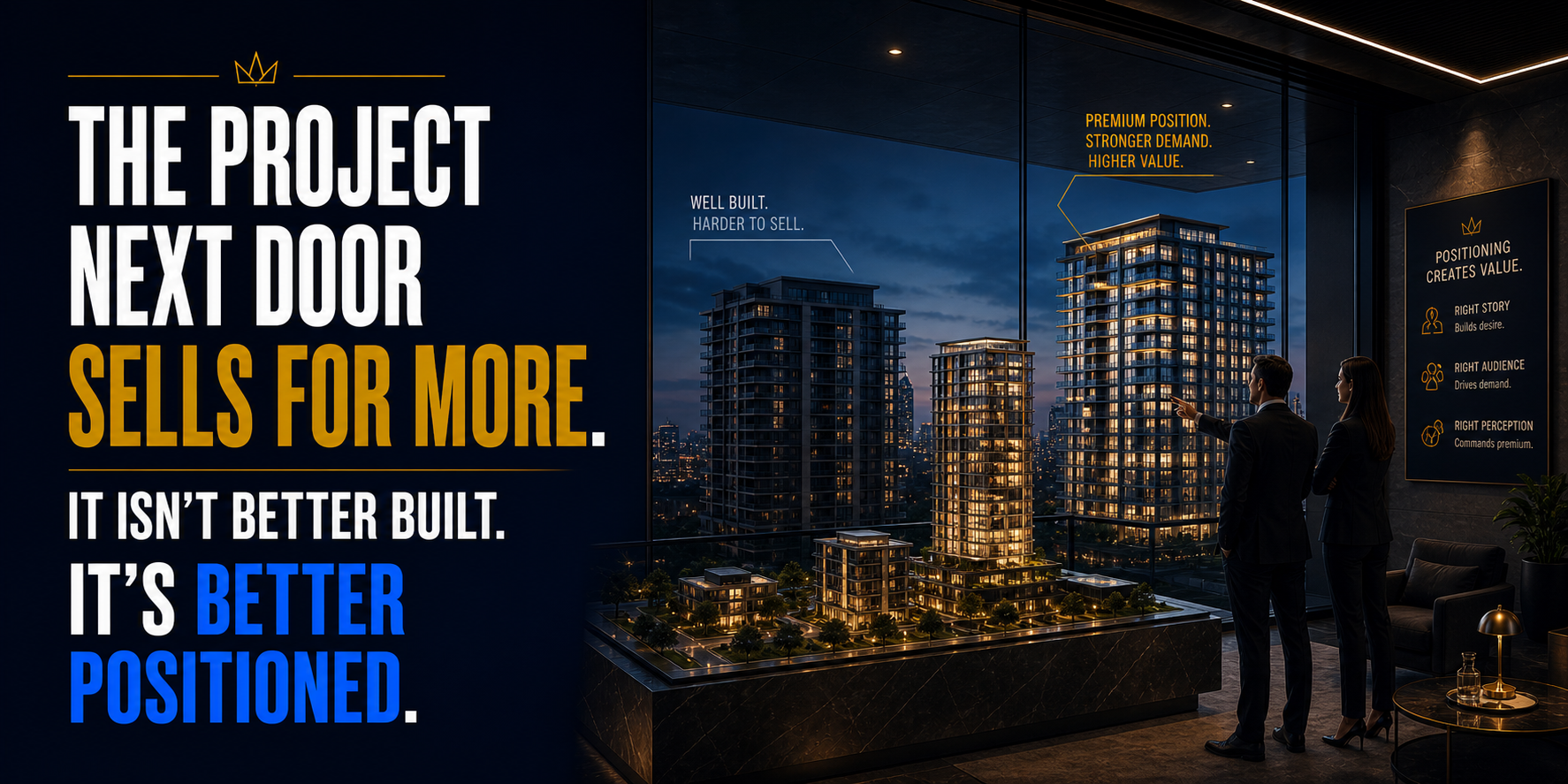
The construction quality is comparable. The location is similar. The finishes are the same tier. And yet the project across the street commands a 20% premium — and sells faster.
Most developers look at that gap and assume they’re losing on product. So they upgrade the lobby. They add a rooftop. They bring in a higher-end contractor.
The product was never the gap.
The buyer didn’t choose the other project because it was built better. They chose it because they understood it faster. Because it occupied a specific place in their mind before they ever walked through the door. Because it had a position — and yours didn’t.
The Break That Most Developers Don’t Name
Real estate developers are trained to think about product. Location, specification, design, price per square meter. These are the variables they control, and they’re right to control them.
But buyers don’t evaluate real estate the way developers build it.
Buyers don’t walk into a showroom with a specification checklist. They walk in with a feeling — a pre-formed sense of whether this development is for someone like them, whether it matches the version of their life they’re building, whether it is distinct enough to justify the commitment.
That feeling is not created by the product. It is created by positioning.
The break is this: most developers invest heavily in the physical asset and almost nothing in the identity of the brand around it. The result is a project that is genuinely good — and completely interchangeable with six others at the same price point. The buyer can’t choose it with conviction because they can’t articulate why it’s the right one. When they can’t articulate it, they hesitate. When they hesitate, they compare on price. And when they compare on price, your margin disappears.
What the Market Is Actually Buying
The market does not buy the best product. This is not an opinion — it is observable in every real estate market across the region.
Emaar doesn’t sell at a premium because their concrete is poured differently. Aldar doesn’t command the prices it does because its tiles are superior. They sell at a premium because they own a position. Emaar means a certain kind of aspiration. Aldar means a certain kind of Abu Dhabi life. The buyer knows exactly what they’re buying before they see the floor plan.
That clarity — the ability to occupy a specific and defensible position in the buyer’s mind — is what allows a developer to set a price and hold it. Not discount it under pressure. Not negotiate it away in the final week before launch.
When a project has no defined position, the sales team fills the gap with features. Features are easy to compare. And everything that is easy to compare gets competed down.
Position is not easy to compare. Position is owned.
The Pricing Power Problem
Undefined positioning has a direct cost on the price per square meter. Not a theoretical cost — a real one, visible in the difference between launch price and final sold price.
Here is the sequence of how it happens.
The project launches without a defined identity. The marketing communicates specifications — location, finish, size, amenity. The target audience is broad because nobody made a hard decision about who this is specifically for. The first inquiries come in. The sales team gets into conversations. Buyers start comparing. They bring comparable projects to the table. The sales team responds with counter-comparisons, then concessions. The price holds for a few weeks, then quietly slides. By the time the project is 60% sold, the average transaction price is below the original target. The developer calls it “market conditions.”
It wasn’t market conditions. It was the absence of positioning.
A project with a defined identity doesn’t enter that sequence. The buyer who arrives at a positioned project arrives pre-qualified — not by income, but by alignment. They already understand what this is. They’re not comparing it to the project next door because in their mind those are not the same thing. One is generic. One is theirs.
The positioned project closes faster, at higher price, with less negotiation. Not because the sales team is better. Because the work was done upstream.
What Positioning Actually Means for a Development
Positioning is not a tagline. It is not a logo. It is not a color palette or a name that sounds like somewhere in Europe.
Positioning is the answer to one question, made precise enough to be operationally useful:
Who is this specifically for, and what does owning this project mean for their life?
Not “young professionals.” Not “families seeking quality.” Those are categories, not positions. A position is specific enough that it automatically excludes. A development positioned for the ambitious Saudi professional who is building the first chapter of an independent life is not for everyone. It is exactly for that person — and that person feels it the moment they walk in.
That specificity is not a risk. It is the source of pricing power.
When a development tries to be for everyone, it is compelling to no one. When it is built around a precisely defined identity — a specific buyer, a specific moment in their life, a specific promise — it becomes the only logical choice for that buyer. And the only logical choice does not negotiate.
The System: Build the Identity Before the Marketing Brief
The mistake developers make is treating positioning as a marketing problem. It is not. Positioning is built before the marketing brief is written. Before the campaign goes to the agency. Before the showroom is designed.
The sequence that produces pricing power has four steps, and they run in this order.
Define the buyer as a situation, not a demographic. Not “35–50, HNW, family.” A situation: “A Saudi family relocating from Riyadh to the Eastern Province for a career transition, buying their first owned home, prioritizing a sense of established community over novelty.” That specificity changes everything — the product decisions, the pricing, the channel, the sales conversation.
Name what this development makes possible for them. Not the features. The transformation. What is true about their life after they own this that wasn’t true before? That answer is the core of the positioning. It must be specific enough to be felt, not just understood.
Identify the enemy. What is the default alternative — and why is it wrong for this buyer? The developer who names the enemy doesn’t compete on price. They compete on fit. And fit is not comparable.
Build the through-line. Every decision from this point — the name, the visual identity, the sales script, the broker briefing, the launch event — runs through one question: does this reinforce the position or dilute it? A through-line is not a style guide. It is a decision filter. And it is the thing that makes a development feel coherent instead of assembled.
These four, built before the agency is briefed, produce something no specification sheet can produce: a project that the right buyer recognizes as theirs.
One Signal Worth Testing Before Launch
Before the campaign goes live, give any person outside the project one sentence describing the development — not the specifications, the identity. Watch how they respond.
If their first question is “how much per square meter” — the identity isn’t defined yet. They defaulted to price because they had nothing else to hold.
If their first response is “that sounds like it’s for someone like X” — the position is working. They placed it. And something they can place, they can choose.
That response is the difference between a project that negotiates and a project that holds.
Proof
A residential developer in the Eastern Province launched two phases of the same project eighteen months apart. Phase one had no defined positioning — the marketing communicated location and specification. The average discount at close was 8%. Phase two was built around a defined identity — a specific buyer profile, a named transformation, a through-line that ran from the name through the sales team’s language. The average discount at close was under 1%. Same market. Same product tier. The positioning was the only variable that changed.
The project next door isn’t outbuilding you. It’s outpositioning you. The gap closes upstream — before the brief, before the campaign, before the launch.